
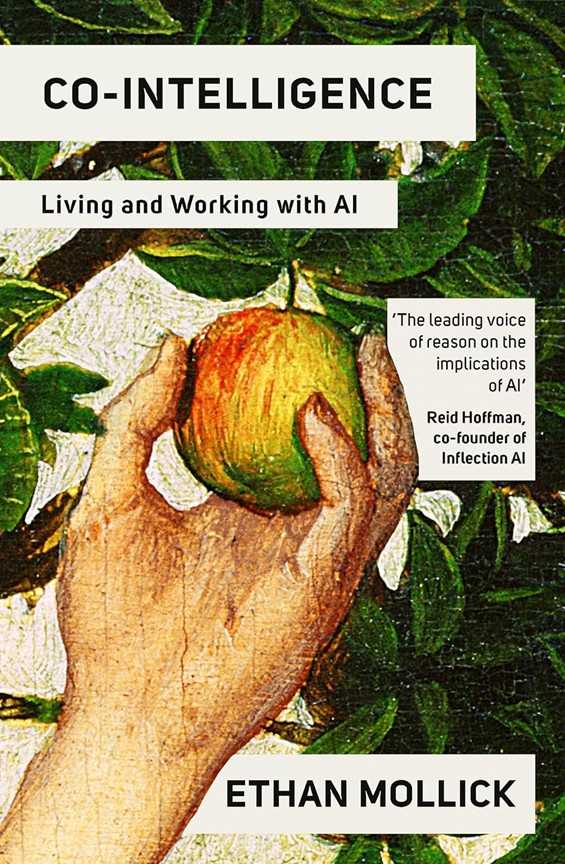
I read a lot. Occupational requirement, I would say, though honestly it has always been more compulsion than duty. And I have read a lot of AI books over the past three years. Most of them fall into one of two categories: breathless optimism dressed up as business strategy, or existential alarm dressed up as serious analysis. Ethan Mollick’s Co-Intelligence: Living and Working with AI is neither, which is exactly why it stands out.
Mollick is a professor at the Wharton School of Business who has been systematically studying how AI changes work, learning, and organizational behavior. He approaches the subject with the rigor of a researcher and the clarity of someone who has actually had to explain these ideas to executives who are both curious and confused. The result is the most practically useful book on AI for leaders that I have come across.
The central argument is deceptively simple: treat AI as a collaborator, not a tool. The distinction matters more than it might initially seem. Tools are passive. You use a hammer; you do not work with it. A collaborator has capabilities, limitations, and a particular kind of intelligence that you need to understand and adapt to. The book’s title captures this framing precisely: the idea that the most productive AI use emerges from a genuine partnership between human and machine judgment.
The four rules that actually stick
Mollick offers four principles for working effectively with AI, and they are practical enough that I found myself coming back to them in actual working situations. First: always invite AI to the table, meaning that before concluding that a task does not benefit from AI involvement, you should actually try it. Second: be the human in the loop, because AI augments judgment but does not replace it, and the human decision-maker remains responsible for outcomes. Third: treat AI as a person rather than a search engine, meaning you should engage conversationally, provide context, push back on outputs that seem wrong, and iterate. Fourth, and his favorite: assume that the AI you are using today is the worst AI you will ever use. Every version will be more capable. The habits you build now will compound.
That last principle has significant implications for organizational strategy. Companies that are waiting until AI is good enough to invest in adoption are making a category error. The learning is in the doing. The organizations that have been genuinely using AI in their workflows for the past two years have developed institutional capability that no amount of retroactive training will replicate. The productivity gap between early movers and late movers is not about the AI. It is about the humans who learned to use it.
What CIOs can take from it
Reading Co-Intelligence through a technology leadership lens, the book functions as a change management guide. Mollick is fundamentally making an argument about organizational behavior and individual mindset, not about specific tools or platforms. That framing is extremely useful for CIOs trying to drive AI adoption inside complex organizations full of people with varying levels of enthusiasm and anxiety.
The section on AI as a co-teacher is particularly relevant for organizations building internal AI literacy programs. Mollick’s observation that AI can dramatically accelerate skill development when used as a patient, personalized tutor is something I have seen play out in practice. The question for technology leaders is whether they create the conditions for that learning to happen at scale, or leave it to individual initiative.
My recommendation: give this book to your direct reports and read it before your next leadership offsite. Then have the conversation it prompts. The bottleneck in most AI transformations is not the technology. It is the willingness of the leadership team to genuinely engage with what AI can do, and to model that engagement for the rest of the organization. This book is a good starting point for that conversation.
Discover more from In-Movement
Subscribe to get the latest posts sent to your email.
